

Our universe's expansion is still accelerating despite recent claims suggesting otherwise, an international team of astrophysicists say.
They refuted a study published last year claiming the growth of the universe is slowing and insist there is no flaw in the widely-accepted theory that a mysterious force known as dark energy is driving the expanding cosmos.
The researchers, who include two Nobel Laureates and represent institutions worldwide, say the debate that followed last November’s revelations was the result of a scientific misunderstanding rather than a cosmic grenade threatening to blow apart everything we know about the universe.
Their paper has been published today in Monthly Notices of the Royal Astronomical Society.
It is a direct rebuttal of a study by a team of South Korean researchers that made the erroneous claim the universe's expansion may have entered a deceleration phase, caused by the influence of dark energy – which acts as a kind of anti-gravity – weakening over time.
"The previous and well accepted measurements were, in fact, fine and our current understanding of the fate of the universe remains robust," said lead author Dr Phil Wiseman, from the University of Southampton.
"Thankfully we have averted this crisis, but the mystery about why the rate of expansion of the universe is still accelerating remains.
"By proving our measurements are correct, we can get back to trying to understand what this dark energy actually is, rather than wondering if it exists at all."
The international team of researchers involved in the new study included Professor Adam Riess and Professor Brian Schmidt, who won the 2011 Nobel Prize in Physics alongside Professor Saul Perlmutter.
The trio studied Type Ia supernovae – violent, luminous white dwarf star explosions – and determined that more distant objects appeared to move faster, leading to their conclusion that the universe's expansion was accelerating.
This has been the globally-accepted theory ever since, although last year's research by the South Korean team threatened to upset the apple cart. It claimed that, as the universe aged, these supernovae had different maximum brightnesses, tricking astronomers into thinking the cosmos was accelerating when it was in fact slowing.
But the University of Southampton-led researchers found an error in how the age of these stars was estimated. They say the previous findings incorrectly assumed the age of a galaxy was the same as the age of the star that exploded.
The experts also said the South Korean paper failed to account for the mass of host galaxies, a standard correction used in modern cosmology to prove accuracy.
Professor Riess added: "Extraordinary claims require especially careful testing.
"What we find is that when we calibrate these supernovae, accounting for different host environments and populations, the evidence for cosmic acceleration remains remarkably consistent."
Professor Mark Sullivan, also from the University of Southampton, said challenging accepted theories and observations was fundamental to science.
"This is how progress is made. Although this idea did not turn out to be correct, it has opened up new ways of thinking about how supernovae explode and how we can measure dark energy more accurately," he added.
Fellow co-author Dr Brodie Popovic agreed. "We've recently been really focused on astrophysics of the explosions and how they impact cosmology," he said.
"This was a good opportunity to go back and go over all of our assumptions – it turns out, yes, we do understand this stuff and we're accounting for it in our cosmology measurement."
ENDS
Media contacts
Sam Tonkin
Royal Astronomical Society
Mob: +44 (0)7802 877 700
James Haigh
University of Southampton
Mob: +44 (0)7584 368684
Science contacts
Dr Phil Wiseman
University of Southampton
Dr Brodie Popovic
University of Southampton
Images & video
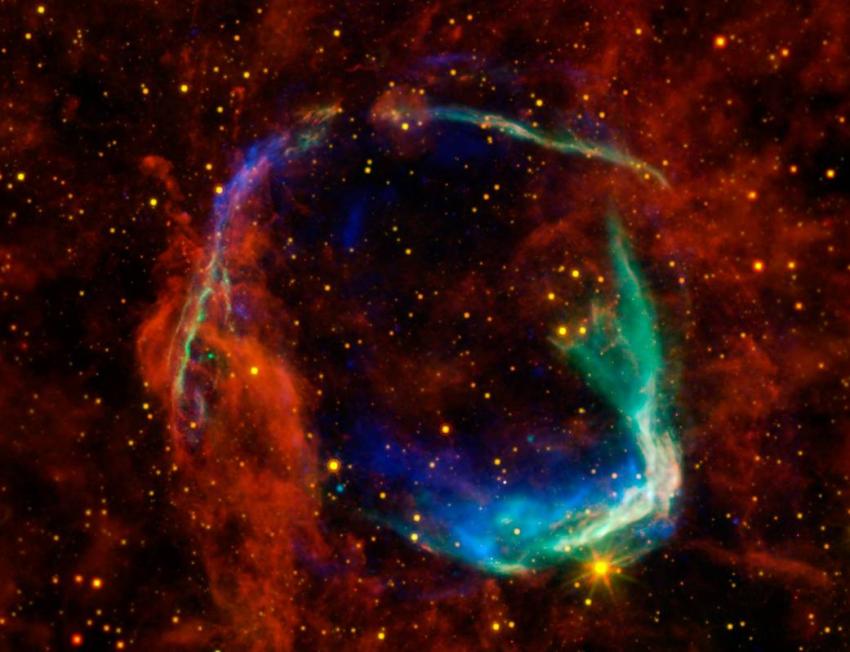
Caption: Studying Type Ia supernovae – violent, luminous white dwarf star explosions – led to the Nobel Prize-winning discovery that the universe's expansion is accelerating. This image combines data from four space telescopes to create a multi-wavelength view of all that remains of RCW 86, the oldest documented example of a supernova.
Credit: X-ray: NASA/CXC/SAO & ESA; Infared: NASA/JPL-Caltech/B. Williams (NCSU)
Caption: This animation shows the explosion of a Type Ia supernova, where the white dwarf's gravity steals material away from a nearby stellar companion until it can no longer sustain its own weight and blows up.
Credit: NASA/JPL-Caltech
Further information
The paper 'Still Accelerating: Type Ia supernova cosmology is robust to host galaxy age evolution' by Wiseman et al. has been published in Monthly Notices of the Royal Astronomical Society. DOI: 10.1093/mnras/stag797.
Notes for editors
About the Royal Astronomical Society
The Royal Astronomical Society (RAS), founded in 1820, encourages and promotes the study of astronomy, solar-system science, geophysics and closely related branches of science.
The RAS organises scientific meetings, publishes international research journals, recognises outstanding achievements by the award of medals and prizes, maintains an extensive library, supports education through grants and outreach activities and represents UK astronomy nationally and internationally. Its more than 4,000 members (Fellows), a third based overseas, include scientific researchers in universities, observatories and laboratories as well as historians of astronomy and others.
The RAS accepts papers for its journals based on the principle of successful peer review, following which experts on the Editorial Boards accept the papers for publication. The Society issues press releases based on a similar principle, but the organisations and scientists concerned have overall responsibility for their content.
Keep up with the RAS on Instagram, Bluesky, LinkedIn, Facebook and YouTube.
Download the RAS Supermassive podcast