


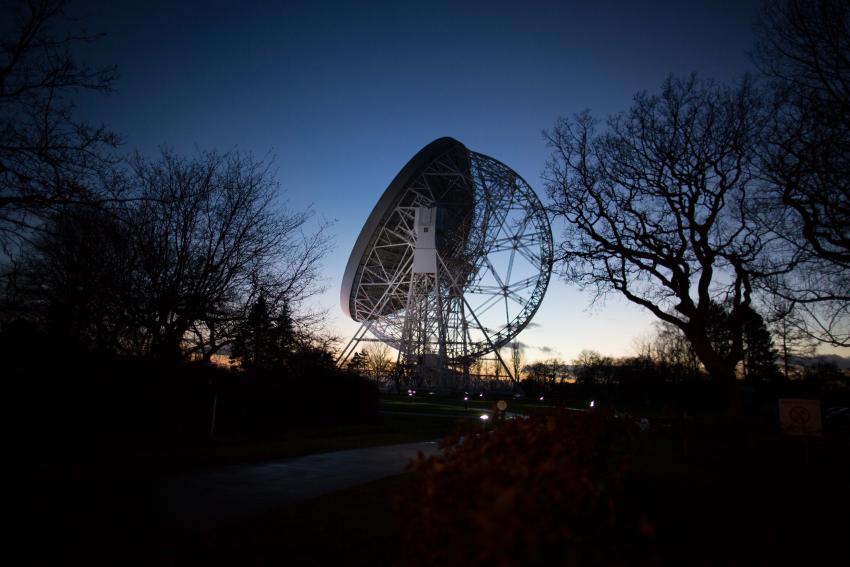

The Royal Astronomical Society (RAS) is shocked and dismayed to hear that the UK's iconic Jodrell Bank Observatory is at risk of closure amid a slew of catastrophic budget cuts.
This deeply troubling development is one of several heavy blows to UK astronomy brought about by widespread funding cuts by the Science and Technology Facilities Council (STFC).
It follows the news that STFC is withdrawing all funding for e-MERLIN (Enhanced Multi-Element Radio Linked Interferometer Network), a group of seven UK radio telescopes including the iconic Lovell Telescope at Jodrell that make up one of the world's most powerful stargazing systems.
Other casualties in the long list of funding cuts include UK withdrawal from the James Clerk Maxwell Telescope (JCMT) located in Hawaii, 20 per cent cuts for the UK's Square Kilometre Array Regional Centre and activities at the Vera Rubin Telescope in Chile, while the BISON solar observing network will suffer cuts of 40 per cent.
RAS President Professor Jim Wild said: "This is devastating news for UK astronomy.
"At a time when technological innovation is crucial to our country's prospects, discarding unique, globally significant observatories threatens both our scientific future and the inspiration of future generations of astronomers."
STFC is rolling out a controversial savings programme as it attempts to balance its budget by 2030.
It had been feared that astronomy, particle physics and nuclear physics (PPAN) could be hit by disastrous cuts of around 30 per cent, but after extensive lobbying and campaigning by leading scientists and the RAS, a headline cut of 2.7 per cent was announced earlier this month.
This news was cautiously welcomed by the RAS, but the latest development illustrates the perilous and uncertain future facing astronomy and the wider scientific ecosystem. Within the 2.7 per cent headline, 10 per cent cuts to the experiments and instruments used by professional astronomers were expected.
Professor Wild added: "The Society is actively working to evaluate the full extent of these cuts to understand their true impact on our community.
"Our immediate priority is to assess whether the announced 10 per cent reductions are what is actually being implemented on the ground, and we will continue to hold the research council and ministers to account throughout this process."
ENDS
Media contacts
Sam Tonkin
Royal Astronomical Society
Mob: +44 (0)7802 877 700
Dr Robert Massey
Royal Astronomical Society
Mob: +44 (0)7802 877 699
Further information
A full list of the project cuts can be found here – Explainer: STFC prioritisation outcomes 2026 to 2030.
Notes for editors
About the Royal Astronomical Society
The Royal Astronomical Society (RAS), founded in 1820, encourages and promotes the study of astronomy, solar-system science, geophysics and closely related branches of science.
The RAS organises scientific meetings, publishes international research journals, recognises outstanding achievements by the award of medals and prizes, maintains an extensive library, supports education through grants and outreach activities and represents UK astronomy nationally and internationally. Its more than 4,000 members (Fellows), a third based overseas, include scientific researchers in universities, observatories and laboratories as well as historians of astronomy and others.
The RAS accepts papers for its journals based on the principle of successful peer review, following which experts on the Editorial Boards accept the papers for publication. The Society issues press releases based on a similar principle, but the organisations and scientists concerned have overall responsibility for their content.
Keep up with the RAS on Instagram, Bluesky, LinkedIn, Facebook and YouTube.
Download the RAS Supermassive podcast