

A leading figure in the study of black holes has been appointed as the new Editor-in-Chief of Monthly Notices of the Royal Astronomical Society (MNRAS), one of the world's largest and most prestigious astronomy journals.
Professor Matthew Middleton, of the School of Physics and Astronomy at the University of Southampton, will take over from Professor David Flower at the end of 2026.
Next year the journal will celebrate its bicentenary, having first been published in 1827.
"In a rapidly changing world, there has never been a more important time to ensure the quality and integrity of published science," Professor Middleton said.
"I am deeply honoured to be able to take the journal into its next chapter, and excited to celebrate its 200th anniversary with the huge community the journal supports."
MNRAS is the flagship journal of the Royal Astronomical Society (RAS) and publishes over 2,300 articles each year. It is a peer-reviewed scientific journal which publishes the results of original research in astronomy and astrophysics, including work which is observational or theoretical. Subjects include radio astronomy, cosmology and space research.
MNRAS has been fully Open Access since 1 January 2024 – enabling everyone in the global community to have free, immediate, and unrestricted access to the high-quality research it publishes. The journal is published by Oxford University Press on behalf of the RAS.
Ian Russell, Executive Director of the RAS, said: "We're delighted to have appointed Matthew as Editor-in-Chief of Monthly Notices. His energy, drive, enthusiasm and passion for both the journal and the Society make him an excellent choice to lead the Editorial Board.
"This is an extremely exciting time for the journal and we're very much looking forward to working with Matthew to ensure we're meeting the evolving needs of authors and readers as the publication moves into its 200th year and beyond."
Professor Middleton is a former RAS Council member, RAS vice president and a longstanding Fellow.
As an RAS Council member from 2019-2022, he contributed to policy of the Society and that of the wider UK astronomy community, while also spearheading the creation of the journal RAS Techniques and Instruments (RASTI).
He was awarded his PhD in astronomy from the University of Durham in 2010, later working as a Marie-Curie Fellow at the University of Amsterdam from 2012-2014, and as an STFC Ernest Rutherford Fellow at Cambridge until 2016. Professor Middleton then joined the University of Southampton, where he currently holds the position of Professor of Astrophysics.
His research interests focus on the nature of accretion onto compact objects, specifically black holes, which are arguably the most enigmatic yet important objects for defining the observational appearance of galaxies over cosmic time.
Professor Middleton is also a senior figure in the international X-ray astronomy community and holds leadership roles in major missions of the European Space Agency (ESA) and UK Space Agency (UKSA), including ESA's NewAthena, which will be the largest X-ray observatory ever built. It will investigate some of the hottest and most energetic phenomena in the universe.
Last year it was announced that Professor Flower would step down as MNRAS Editor-in-Chief after more than a decade in the role. He first joined the MNRAS Editorial Board in 1985 and took over as Editor-in-Chief in 2012, overseeing a board of then 16 editors.
An Emeritus Professor in the Department of Physics at the University of Durham, Professor Flower will remain MNRAS Editor-in-Chief until the end of the year.
ENDS
Media contacts
Sam Tonkin
Royal Astronomical Society
Mob: +44 (0)7802 877 700
Professor Matthew Middleton
Editor-in-Chief, Monthly Notices of the Royal Astronomical Society
Images & captions
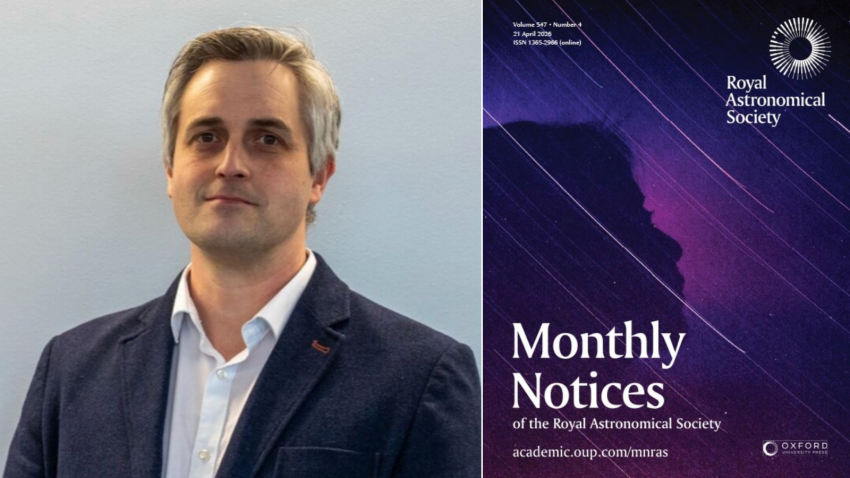
Caption: Professor Matthew Middleton has been appointed as the new Editor-in-Chief of Monthly Notices of the Royal Astronomical Society. He will take over from Professor David Flower at the end of the year.
Credit: Supplied
Notes for editors
About the Royal Astronomical Society
The Royal Astronomical Society (RAS), founded in 1820, encourages and promotes the study of astronomy, solar-system science, geophysics and closely related branches of science.
The RAS organises scientific meetings, publishes international research journals, recognises outstanding achievements by the award of medals and prizes, maintains an extensive library, supports education through grants and outreach activities and represents UK astronomy nationally and internationally. Its more than 4,000 members (Fellows), a third based overseas, include scientific researchers in universities, observatories and laboratories as well as historians of astronomy and others.
The RAS accepts papers for its journals based on the principle of successful peer review, following which experts on the Editorial Boards accept the papers for publication. The Society issues press releases based on a similar principle, but the organisations and scientists concerned have overall responsibility for their content.
Keep up with the RAS on Instagram, Bluesky, LinkedIn, Facebook and YouTube.
Download the RAS Supermassive podcast