Toolbar items

Back to site
Manage

Administration menu

  • Tools
FlexSlider Examples

FlexSlider examples menu

Anonymous

User account actions

  • Log in
Home
Logo RAS Mobile version

Contact us

Support usMy Account Created with Sketch.

Main navigation

  • Home
  • News & Press
    • Latest News
    • Research Highlights
    • Media Enquiries
  • Journals
    • Monthly Notices of the RAS (MNRAS)
    • Geophysical Journal International (GJI)
    • RAS Techniques & Instruments (RASTI)
    • Editorial Boards & Team
    • Editorial Policies
    • Advancing Astronomy & Geophysics
  • Events
    • RAS Meetings
    • External Meetings
    • Public Lectures & Events
    • Friends of the RAS Events
    • Past Events
  • Library
    • Visiting & Using the Library
    • Library Services
    • Archives
    • Other Collections
    • Help with your Research
    • Treasures from the Library & Archives
    • Obituaries
  • Awards & Grants
    • Fellowships
    • Awards, Medals and Prizes
    • Grants for Studies in Astronomy and Geophysics
  • Education & Outreach
    • Podcast
    • Education
    • Outreach
    • Careers
    • RAS200
    • Resources
    • Early Careers
  • About the RAS
    • Bicentenary
    • Burlington House
    • Bye-laws
    • Committees
    • Contacts
    • Council
    • Diversity
    • Sustainability
  • A&G
    • Latest A&G Articles
    • Contact A&G Editor
  • Membership
    • Fellows Membership
    • Friends of the RAS
  • Public Policy
    • Science Policy
    • Impact & Industry
    • Community & Demographics
    • Consultative Forums
  • Timeline
  • NAM 2026
Logo
  • Home
  • News & Press
    • Latest News
    • Research Highlights
    • Media Enquiries
  • Journals
    • Monthly Notices of the RAS (MNRAS)
    • Geophysical Journal International (GJI)
    • RAS Techniques & Instruments (RASTI)
    • Editorial Boards & Team
    • Editorial Policies
    • Advancing Astronomy & Geophysics
  • Events
    • RAS Meetings
    • External Meetings
    • Public Lectures & Events
    • Friends of the RAS Events
    • Past Events
  • Library
    • Visiting & Using the Library
    • Library Services
    • Archives
    • Other Collections
    • Help with your Research
    • Treasures from the Library & Archives
    • Obituaries
  • Awards & Grants
    • Fellowships
    • Awards, Medals and Prizes
    • Grants for Studies in Astronomy and Geophysics
  • Education & Outreach
    • Podcast
    • Education
    • Outreach
    • Careers
    • RAS200
    • Resources
    • Early Careers
  • About the RAS
    • Bicentenary
    • Burlington House
    • Bye-laws
    • Committees
    • Contacts
    • Council
    • Diversity
    • Sustainability
  • A&G
  • Membership
    • Fellows Membership
    • Friends of the RAS
  • Public Policy
    • Science Policy
    • Impact & Industry
    • Community & Demographics
    • Consultative Forums
  • Timeline
  • NAM 2026
The European Space Agency
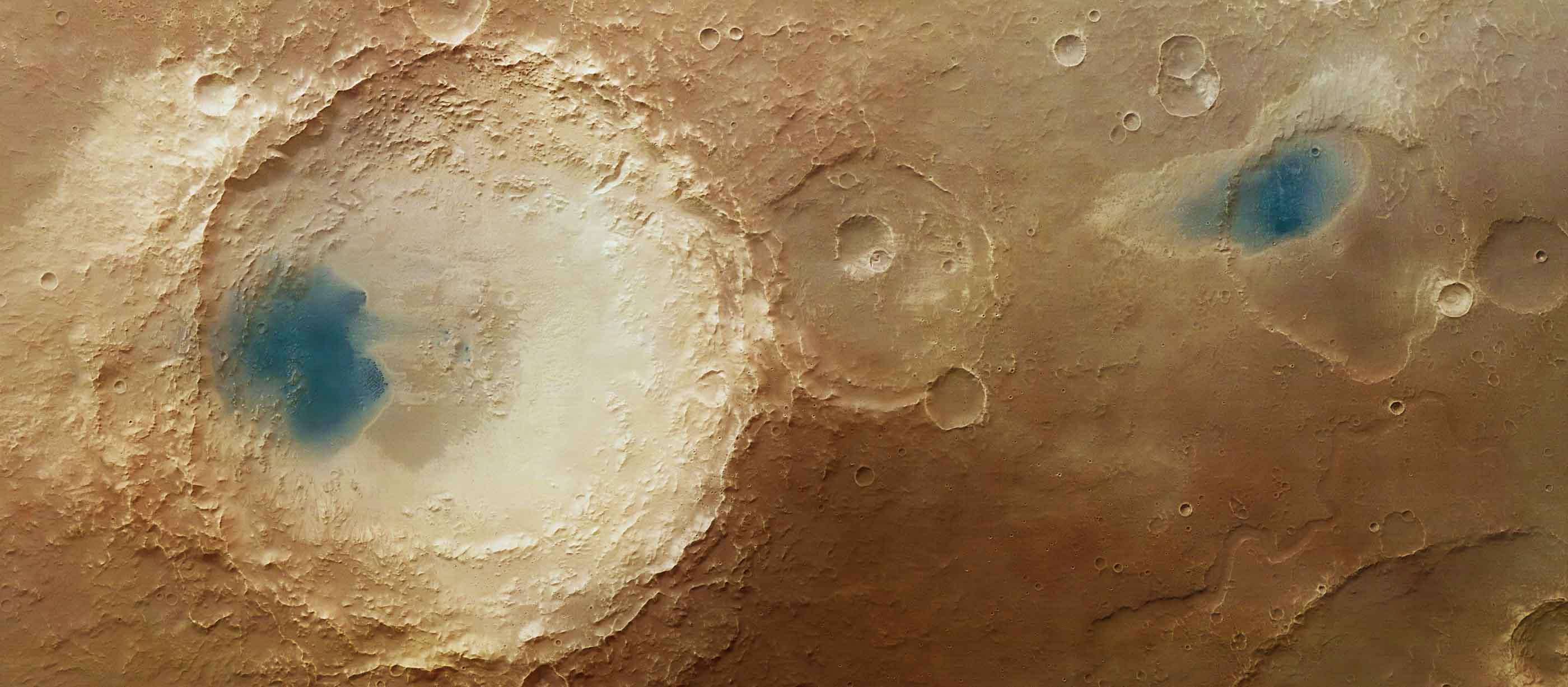
Crater Generations ArabiaTerra
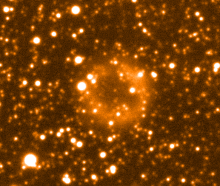
Image from HST showing the bipolar outflow of material ejected by the helium nova V445 Puppis. The progenitor binary star system is just about visible in the centre of the outflow. Also visible are the 'bullets' of gas that were shot out at either end of the outflow. Image taken in 2013 with the F502N filter on Hubble’s Wide Field Camera 3.
News

Mystery 'bullets' spotted in only stellar explosion of its kind in th…

Mysterious high-speed "bullets" – clumps of possibly oxygen-rich gas travelling at up to 20 million miles per hour – have been discovered shooting out of the rarest stellar explosion in our galaxy. They were spotted after a dust...
Halo 18 is an example of a galaxy that had a head-on collision (see the panel at z=1.2) and had a disc flip (you can see this by comparing the disc orientation at z=1.4 and z=0). This image and Image 2 show how these two exemplary galaxies evolve with time: each panel corresponds to a different time defined by redshift (z). Redshift is a quantity used by astronomers to measure the time in the universe, with z=0 corresponding to the present day, and larger z corresponding to earlier times. Each z has two pan
Research Highlights

NAM 2026 - Cosmic gymnastics: How our Milky Way once underwent a dramatic flip

Comparison of Mars before (left) and during (right) the June 2018 dust storm, which coincided with the solar energetic particle event examined by the Lancaster University team. Images taken by the Mars Color Imager (MARCI), a wide-angle camera aboard NASA's Mars Reconnaissance Orbiter (MRO), that maps daily weather conditions across the planet.
Research Highlights

NAM 2026: First study hints solar storms may alter the weather during Martian d…

Read More
The front cover of The Sun as a Star, an online collection of papers celebrating our growing understanding of the Sun over the past two centuries.
New online collection celebrates growing understanding of our Sun
News
Photograph of the MAGIC instrument. This is the flight instrument that has just been finished and will be sent for integration into HENON soon. It is missing the sensor, which is attached by a wire and will be mounted on a deployable boom.
NAM 2026: From 15 minutes to 3 hours – the UK-built instrument that could vastly improve space weather forecasts
Research Highlights
Sunspots are regions of intense magnetic activity on the Sun's surface. The number of sunspots rises and falls over the Sun's approximately 11-year activity cycle and is one of the main ways astronomers track and predict solar activity.
NAM 2026: How the Sun goes to 'sleep' could reveal future space weather when it wakes
Research Highlights
RAS logo placeholder
RAS response to UKRI/STFC funding announcement
News
Image of the Australian desert showing the growing light pollution caused by artificial satellites.
Scourge of satellites could be mitigated with help of ultra-black coating
Research Highlights
Dr Isobel Romero-Shaw
Gravitational waves researcher wins 2026 Caroline Herschel Lectureship
News

Research Highlights

Halo 18 is an example of a galaxy that had a head-on collision (see the panel at z=1.2) and had a disc flip (you can see this by comparing the disc orientation at z=1.4 and z=0). This image and Image 2 show how these two exemplary galaxies evolve with time: each panel corresponds to a different time defined by redshift (z). Redshift is a quantity used by astronomers to measure the time in the universe, with z=0 corresponding to the present day, and larger z corresponding to earlier times. Each z has two pan
Research Highlights
NAM 2026 - Cosmic gymnastics: How our Milky Way once underwent a dramatic flip
Comparison of Mars before (left) and during (right) the June 2018 dust storm, which coincided with the solar energetic particle event examined by the Lancaster University team. Images taken by the Mars Color Imager (MARCI), a wide-angle camera aboard NASA's Mars Reconnaissance Orbiter (MRO), that maps daily weather conditions across the planet.
Research Highlights
NAM 2026: First study hints solar storms may alter the weather during Martian dust storms
Photograph of the MAGIC instrument. This is the flight instrument that has just been finished and will be sent for integration into HENON soon. It is missing the sensor, which is attached by a wire and will be mounted on a deployable boom.
Research Highlights
NAM 2026: From 15 minutes to 3 hours – the UK-built instrument that could vastly improve space weather forecasts
Sunspots are regions of intense magnetic activity on the Sun's surface. The number of sunspots rises and falls over the Sun's approximately 11-year activity cycle and is one of the main ways astronomers track and predict solar activity.
Research Highlights
NAM 2026: How the Sun goes to 'sleep' could reveal future space weather when it wakes
View all

Media Enquiries

‌  020 7292 3979

‌  press@ras.ac.uk

‌  About the RAS press office...

View all

Registered Charity No: 226545
Registered Company
No: RC000446

Useful links

  • Contact
  • Diversity
  • Anonymous Reporting
  • Feedback form
  • Privacy Policy
  • Report Links

RAS

  • About the RAS
  • Awards & Grants
  • Events
  • Journals
  • Library
  • News & Press
  • Public Policy

Membership

  • Become a Fellow
  • Current Fellows
  • Friends of the RAS

Follow us:

Copyright © 2024 Royal Astronomical Society. All Rights Reserved.