


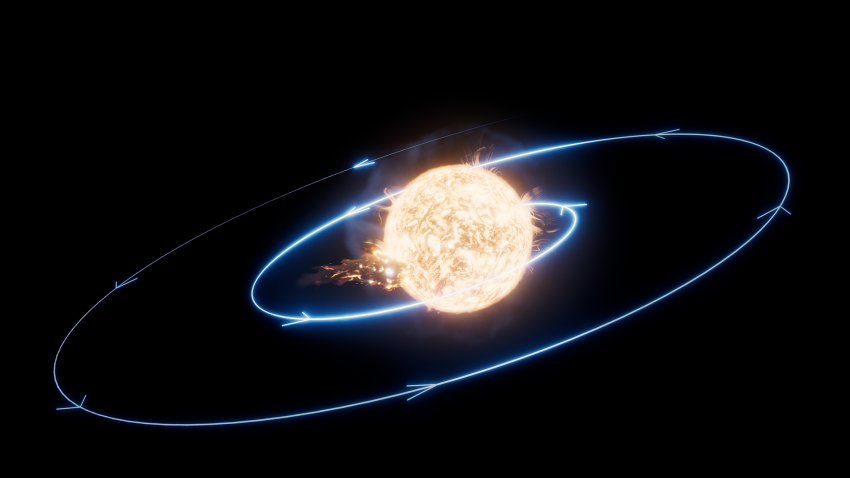

It is thought the Sun may have engulfed a super-Earth-sized planet early in its history.
Now a new study has gone a step further by suggesting that such an event may have left behind detectable clues inside our star which could still be visible today.
This idea of a measurable signature or 'fingerprints' in the present-day solar interior was explored by research published today in Monthly Notices of the Royal Astronomical Society.
Professor Mutlu Yildiz, of Ege University in Turkey, said: "Our new study suggests that a planet several times more massive than Earth may have fallen into the young Sun and left a lasting chemical imprint deep inside it.
"By modelling the Sun's evolution and comparing the results with precise observations of its interior, we find that the ingestion of a super-Earth could help explain long-standing differences between standard solar models and observations, including subtle changes in the Sun's internal structure and its depleted lithium abundance."
Researchers also found that such a world could survive its passage through the Sun's outer layers while losing very little mass, which suggests that planets may leave detectable fingerprints inside their host stars long after they have disappeared.
For many years, solar models based on the standard physics of stellar evolution have had difficulty reproducing some helioseismic observations simultaneously, particularly the sound-speed structure just below the convection zone and the depth of the solar convection zone.
At the same time, the Sun shows a strong and well-known depletion of lithium at its surface.
"We were interested whether these problems might have a common origin in the early chemical history of the Sun," Professor Yildiz explained.
"Young stars are surrounded by protoplanetary discs, where substantial amounts of material can move between the disc and the star.
"Since planets are made of material that is chemically different from the gas in the disc, we wondered whether the early engulfment of a planet could have left a chemical signature inside the young Sun."
The researchers used the MESA stellar-evolution code to test their idea. They explored different accretion histories and compared the resulting solar models with helioseismic constraints and surface abundances, while also testing alternative explanations involving the equation of state, opacity, and different prescriptions for turbulent and convective mixing.
Their results favour a scenario in which the young Sun engulfed a super-Earth around 5–10 times the mass of Earth.
Importantly, their modelling also does not explain just one puzzle. It simultaneously matches several independent measurements of the Sun, including observations of its interior and its unusually low lithium abundance.
"We thought planetary engulfment might affect the solar structure but did not expect the calculations to converge on such a specific super-Earth mass range," said Professor Yildiz. "That was one of the most interesting outcomes of the study."
He added that while it may not be possible to definitively prove the Sun swallowed a planet, if the predicted structural and chemical signature could be independently identified through helioseismic or other observations, it would provide strong evidence for such an event happening billions of years ago.
Astronomers have long wondered why many other star systems appear to have large super-Earths, while ours has none.
The new study cites previous research from a decade ago by Martin & Livio (2016), which suggested that one or more super-Earths could have formed inside the orbit of Mercury and migrated inward through the gas disc, potentially falling into the young Sun.
However, although this research provided a theoretical pathway for an engulfment event, it did not require that such a planet was ultimately swallowed by our star.
"The earlier work proposed that a super-Earth could have formed and migrated into the young Sun. Our paper asks whether the Sun itself could still carry observable evidence that such an engulfment actually happened, and we believe it could," Professor Yildiz concluded.
"The next step is to see if these fingerprints can be independently detected."
ENDS
Media contacts
Sam Tonkin
Royal Astronomical Society
Mob: +44 (0)7802 877 700
Science contacts
Professor Mutlu Yildiz
Ege University
Images & captions
Caption: An artist's impression of a star engulfing a planet. The blue line traces the path of the planet as it spirals toward the star and ultimately collides with it.
Credit: NASA, ESA, CSA, Ralf Crawford (STScI)
Further information
The paper 'Planetary engulfment as a solution to solar-model discrepancies and its implications for planetary systems' by M. Yildiz has been published in Monthly Notices of the Royal Astronomical Society. DOI: 10.1093/mnras/stag1527.
Notes for editors
About the Royal Astronomical Society
The Royal Astronomical Society (RAS), founded in 1820, encourages and promotes the study of astronomy, solar-system science, geophysics and closely related branches of science.
The RAS organises scientific meetings, publishes international research journals, recognises outstanding achievements by the award of medals and prizes, maintains an extensive library, supports education through grants and outreach activities and represents UK astronomy nationally and internationally. Its more than 4,000 members (Fellows), a third based overseas, include scientific researchers in universities, observatories and laboratories as well as historians of astronomy and others.
The RAS accepts papers for its journals based on the principle of successful peer review, following which experts on the Editorial Boards accept the papers for publication. The Society issues press releases based on a similar principle, but the organisations and scientists concerned have overall responsibility for their content.
Keep up with the RAS on Instagram, Bluesky, LinkedIn, Facebook and YouTube.
Download the RAS Supermassive podcast