


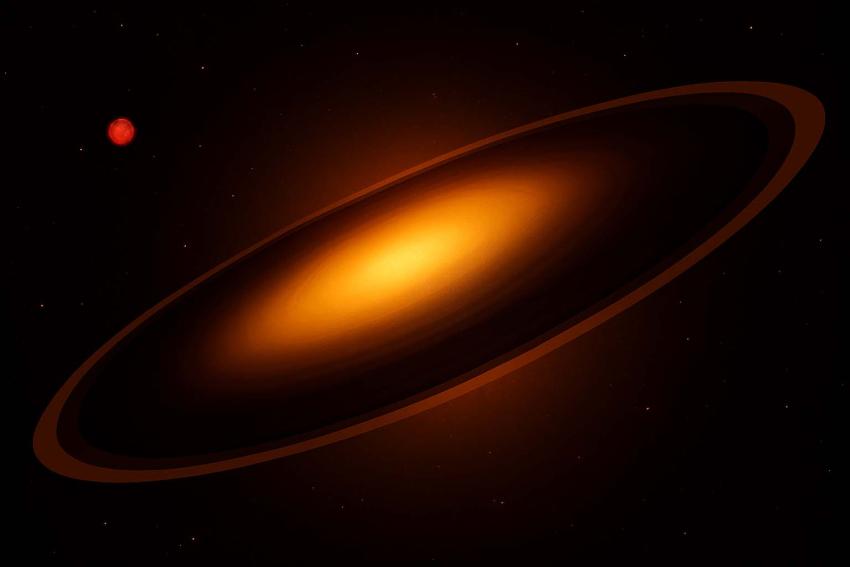

One of the longest stellar dimming events ever observed was likely caused by the gigantic saucer-like rings of either an unseen brown dwarf or 'super-Jupiter' blocking its host star's light, astronomers say.
For decades the star – which sits 3,200 light-years from Earth and is about twice as big as our Sun – had been observed as stable, but at the end of 2024 it faded dramatically.
It then remained this way for more than nine months, far longer than is normal for an event like this, sparking confusion among researchers and prompting speculation as to what could have caused such an "extremely rare" phenomenon.
Now, in a new study published today in Monthly Notices of the Royal Astronomical Society, a team of international researchers believe they may have solved the riddle of this mysterious star in the Monoceros constellation.
They think it was most likely a brown dwarf with Saturn-like rings that caused ASASSN-24fw to dim by about 97 per cent.
This ring system is so enormous it extends out about 0.17 astronomical units, comparable to half the distance between our Sun and Mercury.
Brown dwarfs are mysterious objects that are too big to be considered a planet but also too small to be a star because they lack the mass to keep fusing atoms and blossom into fully-fledged suns.
The other option, the researchers say, is that it may have been a super-Jupiter – defined as massive gas giant exoplanets which exceed the mass of Jupiter and bridge the gap between brown dwarfs and planets.
Their findings offer a glimpse into complex planetary-scale structures beyond our Solar System, paving a new way to study how planets and their rings may form and evolve around other stars.
Unlike typical eclipses, which usually last days or weeks, this dimming continued for nearly 200 days, making it one of the longest ever observed.
"Various models made by our group show that the most likely explanation for the dimming is a brown dwarf – an object heavier than a planet but lighter than a star – surrounded by a vast and dense ring system. It is orbiting the star at a farther distance with the ring," said lead author Dr Sarang Shah, a post-doctoral researcher at the Inter-University Centre for Astronomy and Astrophysics (IUCAA), in Pune, India.
"Long-lasting dimming events like this are exceptionally uncommon as they require very perfect line-ups. The dimming began gradually because the outer parts of the rings are thin, and only became obvious when the denser regions passed in front of the star."
Analysis of photometric and spectroscopic studies of the event suggests that the companion object has a mass of more than three times that of Jupiter.
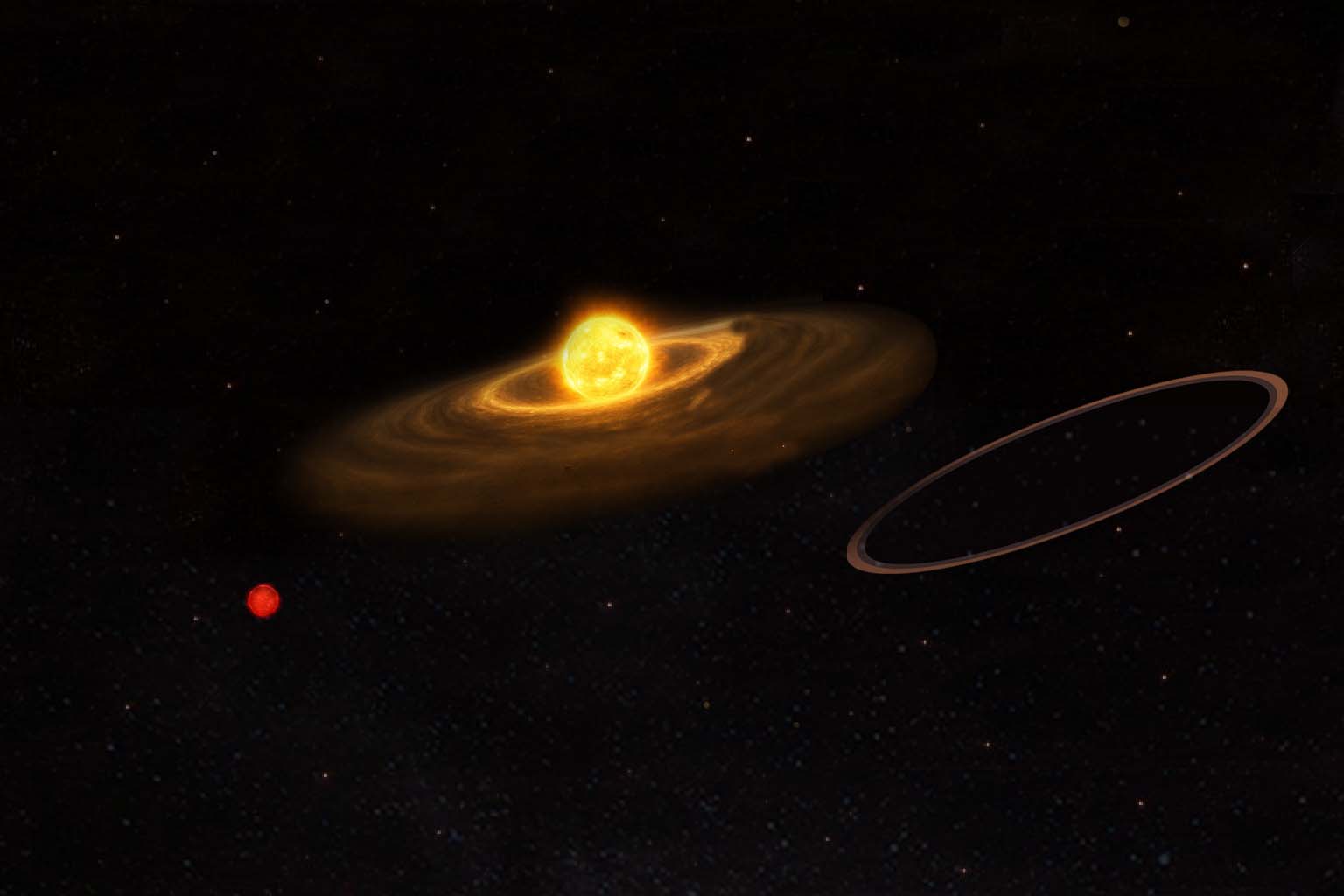
The analysis also shows that ASASSN-24fw itself has a circumstellar environment (possibly remnants from past or ongoing planetary collisions) very near to it, which is unusual for a star of this age (likely more than 1 billion years).
"Large ring systems are expected around massive objects, but they are very difficult to observe directly to determine their characteristics," said Dr Jonathan Marshall, an independent post-doctoral researcher affiliated with Academia Sinica, Taiwan, whose expertise is in circumstellar material and debris discs.
"This rare event allows us to study such a complex system in remarkable detail. In fact, while studying this dimming, we also serendipitously discovered that ASASSN-24fw also has a red dwarf star in its vicinity."
The team of researchers now want to measure the temperature, evolutionary status, chemical composition, and age of the star which dimmed.
They then hope to obtain more data from the European Southern Observatory’s Very Large Telescope in Chile and the James Webb Space Telescope to better understand the evolution of such systems and relate them to planetary formation theories.
The researchers expect the star to dim again in about 42 or 43 years' time, at which point further analysis can be carried out to find out more about this fascinating system.
ENDS
Media contacts
Sam Tonkin
Royal Astronomical Society
Mob: +44 (0)7802 877 700
Science contacts
Dr Sarang Shah
Inter-University Centre for Astronomy and Astrophysics, Pune, India
Dr Jonathan Marshall
Academia Sinica, Taiwan
Images & captions
Caption: An artist's impression of the stellar dimming event caused by a brown dwarf or super-Jupiter with massive rings (foreground) forming an opaque "saucer" through which some light from the star ASASSN-24fw (background) shines. A red dwarf star (left) was also discovered in the neighbourhood during the research.
Credit: S. Shah et al.
Caption: An artist's impression of ASASSN-24fw after the eclipse is over, where the star is seen shining unobstructed – with its own remnants from possible planetary collisions along with its companion red dwarf star and the dark "saucer".
Credit: S. Shah et al.
Further information
The paper 'The nature of ASASSN-24fw's occultation: modelling the event as dimming by optically thick rings around a sub-stellar companion' by S. Shah et al. has been published in Monthly Notices of the Royal Astronomical Society. DOI: 10.1093/mnras/staf2251.
Notes for editors
About the Royal Astronomical Society
The Royal Astronomical Society (RAS), founded in 1820, encourages and promotes the study of astronomy, solar-system science, geophysics and closely related branches of science.
The RAS organises scientific meetings, publishes international research and review journals, recognises outstanding achievements by the award of medals and prizes, maintains an extensive library, supports education through grants and outreach activities and represents UK astronomy nationally and internationally. Its more than 4,000 members (Fellows), a third based overseas, include scientific researchers in universities, observatories and laboratories as well as historians of astronomy and others.
The RAS accepts papers for its journals based on the principle of peer review, in which fellow experts on the editorial boards accept the paper as worth considering. The Society issues press releases based on a similar principle, but the organisations and scientists concerned have overall responsibility for their content.
Keep up with the RAS on Instagram, Bluesky, LinkedIn, Facebook and YouTube.
Download the RAS Supermassive podcast