



Exploring the Distant Universe with Cosmic Explosions
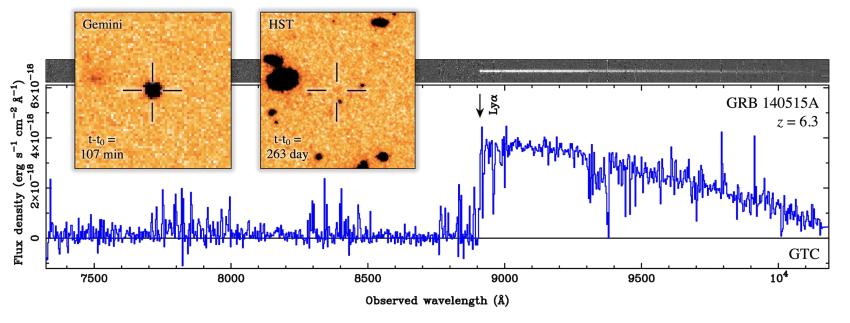
Gamma-ray bursts (GRBs) are brief flashes of high-energy radiation that at their peak are the most luminous sources known in the Universe. They arise from the cataclysmic explosions of massive stars at the ends of their lives. Being so bright, GRBs can be detected at great distances and hence early times. Thus, they provide unique windows on the stars and galaxies that were forming in the first billion years after the Big Bang, even when their host galaxies are themselves undetectable. I will describe what we have learnt so far from GRB studies, and highlight the particular role they play in resolving the puzzle of the reionisation of the intergalactic medium.
Speaker Biography:
Nial Tanvir is Professor in Physics and Astronomy at the University of Leicester. He has made important contributions to several areas of astrophysics, notably the extragalactic distance scale and the structure and evolution of galaxies.
Nial is particularly recognised for his pioneering work on gamma-ray bursts, the most luminous and violent explosions known to science. In 2009 he headed the team that measured the distance to a gamma-ray burst that was the most distant object identified up to that time. In 2013 he revealed the first evidence for a so-called 'kilonova' explosion, confirming that collisions of ultra-dense neutron stars likely produce many of the heavy elements in the Universe, including gold and platinum. This breakthrough paved the way for his co-discovery in 2017 of a kilonova for which the neutron star collision was also detected with gravitational waves for the first time.
Nial has helped found and lead several major international consortia, including the STARGATE, VINROUGE and ENGRAVE collaborations. He was co-recipient of the 2002 EU Descartes Prize, in 2019 was awarded the Herschel Medal of the Royal Astronomical Society, and in 2025 was awarded the Danish Government's Into Change Prize.
This talk is exclusively for Friends of the RAS members
Want to attend talks like this? Learn more about becoming a Friend and get access to special events, talks, newsletters, and more.