
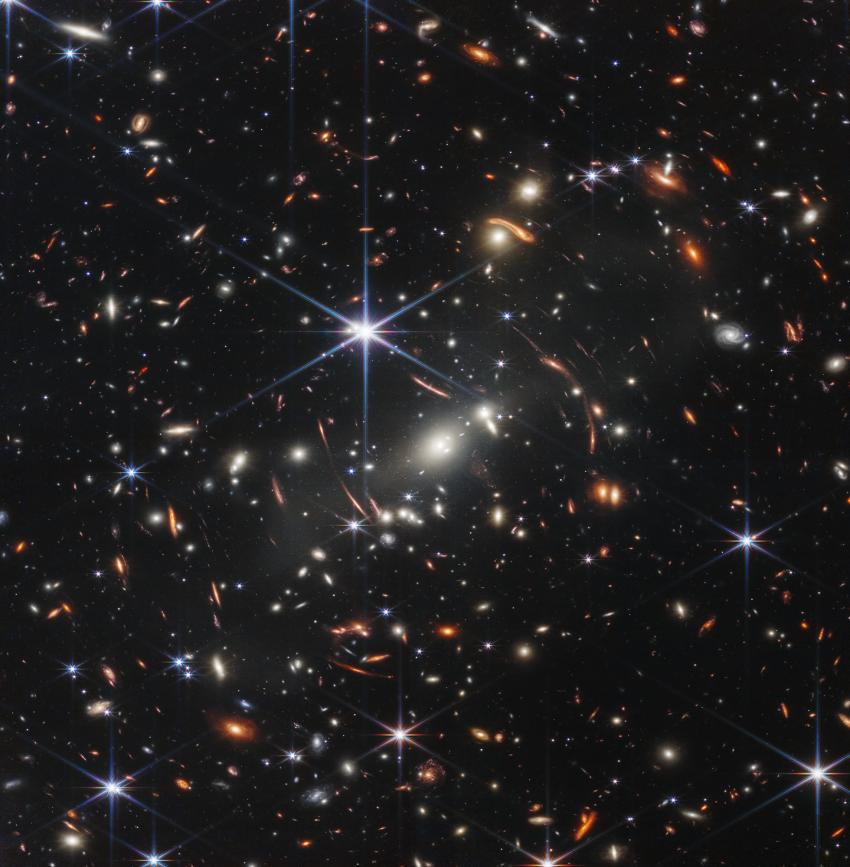

Finding and understanding the nature of the first stars at 'Cosmic Dawn' is one of the most important and most ambitious goals for modern astrophysics. The first populations of stars produced the first chemical elements heavier than helium and formed the first small protogalaxies, which then evolved into the large, mature galaxies such as the Milky Way and its neighbours. Equally important and challenging is the search, in the early Universe, for the seeds of the first population of black holes, which later evolved into the supermassive black holes at the centre of galaxies, with masses even exceeding a billion times the mass of the Sun.
Since its launch a few years ago, the James Webb Space Telescope has been revolutionising this area of research. Its sensitivity in detecting infrared light from the remotest parts of the Universe is orders of magnitude higher than any previous observatory, an historical leap in astronomy and, more broadly, in science. I will presents some of the extraordinary discoveries from the Webb telescope, which have resulted in several unexpected findings. I will also discuss the new puzzles and areas of investigation that have been opened by Webb’s observations, how these challenge theoretical models, and the prospects for further progress in the coming years.
Speaker biography:
Roberto Maiolino is Professor of Experimental Astrophysics in the Department of Physics and at the Kavli Institute for Cosmology, University of Cambridge. He is also an Honorary Professor at University College London and a Royal Society Research Professor.
He has served as Director of the Kavli Institute for Cosmology, Cambridge, and is a Fellow of the Royal Society. He was knighted by the President of Italy in the Order of the Star of Italy and was awarded the Blaauw Honorary Professorship at the University of Groningen.
His research focuses on the formation of galaxies and black holes, using observations from some of the largest ground-based and space telescopes. He has played a leading role in several major projects, including the James Webb Space Telescope, the MOONS spectrograph for the European Southern Observatory's Very Large Telescope, and the ANDES spectrograph for ESO's Extremely Large Telescope.
This talk is exclusively for Friends of the RAS members
Want to attend talks like this? Learn more about becoming a Friend and get access to special events, talks, newsletters, and more.
Accessibility Information
Please note that this venue is currently not wheelchair accessible as the ramp is temporarily out of order, and step-free access is unavailable.
We sincerely apologise for any inconvenience caused. We are committed to improving accessibility and are working to address this.
If you have any specific access requirements or questions, please contact us at events@ras.ac.uk or call us on 020 7734 4582 .