



Astronomers have found some of the strongest evidence yet that stars can swallow their own planets.
A new study, published in Monthly Notices of the Astronomical Society, supports the long-held belief that young stars are capable of 'eating' nearby worlds as planetary systems form.
Researchers from Keele University and the University of Exeter studied thousands of stars and found evidence that six different red dwarfs – the smallest, coolest, and most common type of star in the universe – had engulfed Earth-like rocky planets.
What gave it away was the highly detectable chemical 'fingerprint', said lead author Professor Robin Jeffries, from Keele University.
"We found that a few of the red dwarf stars we studied contained lithium, a chemical element that should not be there," he explained.
"Therefore even a small amount of lithium stands out clearly in these stars – a bit like throwing paint onto a blank canvas."
Professor Jeffries added: "Red dwarfs are smaller and cooler than our Sun but inside they are extremely hot. This heat should destroy all of their fragile lithium in nuclear reactions shortly after they form."
Because of this, there have been previous predictions that finding the presence of lithium in their atmospheres could signpost the engulfment of still lithium-rich material accreted from a surrounding planetary system.
In the new study, the researchers looked at young star clusters using spectroscopic data, which refers to the study of how different matter interacts with electromagnetic radiation.
The Gaia-ESO Spectroscopic (GES) survey data covered thousands of stars, of which the team identified six different red dwarfs in three separate clusters which had much higher lithium content than other stars of a similar spectral type.
Their analysis suggests that these stars had dramatically ‘swallowed’ their surrounding Earth-like planets, or about 3 to 10 Earth-masses of planetary material in total, providing a fresh burst of lithium to their otherwise lithium-depleted atmospheres.
These engulfment events have long been theorised as a possible and even probable outcome during early planetary system formation, and may even have happened earlier in our own Solar System.
If this explanation proves correct, a new window will have been opened into the early lives of planetary systems, allowing the quantity and timing of planetary engulfment to be investigated.
Unlike isolated stars, those found in clusters have well-understood ages and masses, and the presence of many similar siblings, born from the same initial material, means even small chemical abundance differences are easier to establish, the researchers said.
ENDS
Media contacts
Sam Tonkin
Royal Astronomical Society
Mob: +44 (0)7802 877 700
Science contacts
Professor Robin Jeffries
Keele University
Images & captions
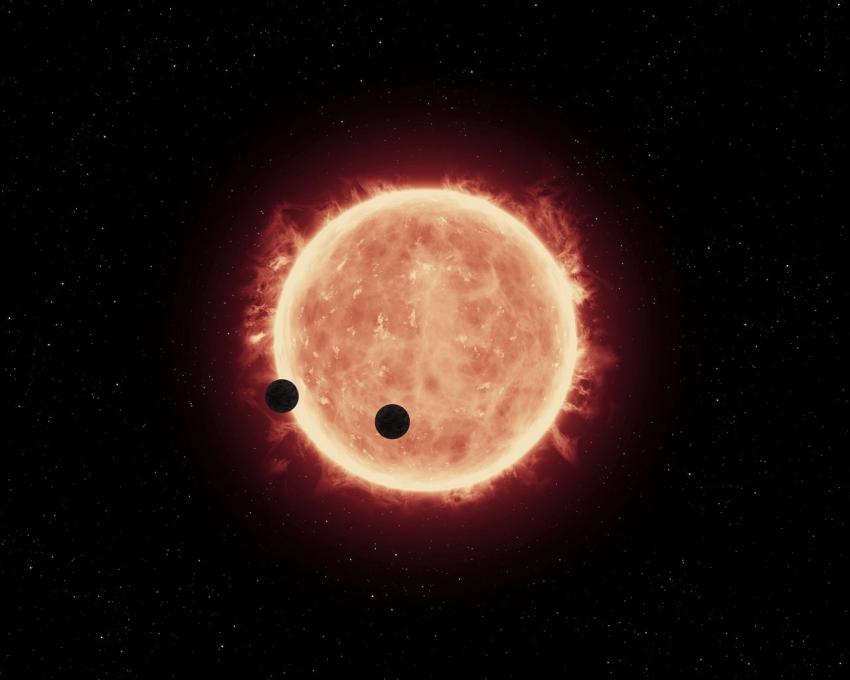
Caption: This artist's impression shows two Earth-sized worlds passing in front of their parent red dwarf star in the TRAPPIST-1 system 40 light-years away.
Credit: ESA/Hubble
Further information
The paper ‘Lithium-rich M-dwarfs at the ZAMS: evidence for planetary engulfment?’ by Jeffries et al. has been published in Monthly Notices of the Royal Astronomical Society. DOI: 10.1093/mnras/stag815.
Notes for editors
About the Royal Astronomical Society
The Royal Astronomical Society (RAS), founded in 1820, encourages and promotes the study of astronomy, solar-system science, geophysics and closely related branches of science.
The RAS organises scientific meetings, publishes international research journals, recognises outstanding achievements by the award of medals and prizes, maintains an extensive library, supports education through grants and outreach activities and represents UK astronomy nationally and internationally. Its more than 4,000 members (Fellows), a third based overseas, include scientific researchers in universities, observatories and laboratories as well as historians of astronomy and others.
The RAS accepts papers for its journals based on the principle of successful peer review, following which experts on the Editorial Boards accept the papers for publication. The Society issues press releases based on a similar principle, but the organisations and scientists concerned have overall responsibility for their content.
Keep up with the RAS on Instagram, Bluesky, LinkedIn, Facebook and YouTube.
Download the RAS Supermassive podcast