
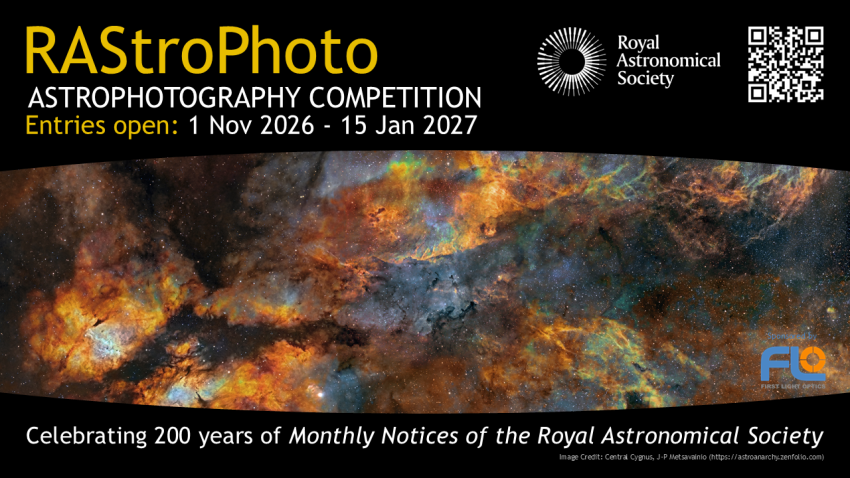

Amateur astrophotographers are invited to share their images capturing the wonder of astronomy for a new photography competition being launched to celebrate the 200th anniversary of Monthly Notices of the Royal Astronomical Society (MNRAS).
First published in 1827, the flagship journal of the Royal Astronomical Society (RAS) is one of the world's largest and most prestigious astronomy journals.
To honour the significant milestone of its bicentenary next year, the journal is holding a commemorative global photography competition called RAStroPhoto which will be open to entrants from 1 November 2026.
It will showcase images taken by amateur astronomers and citizen scientists that capture the beauty of the cosmos, the night sky, and the science or scientists that help us understand the universe.
RAStroPhoto is open to everyone worldwide – entry is free and all skill levels are welcome. Professional equipment is not required.
The categories are:
- Our Solar System
- Deep Sky
- Our Galaxy
- Earth & Space
- Observing Astronomers
The closing date for submissions is 15 January 2027.
All entries must have been taken within five years of the competition opening date and must not have previously been awarded at any other competition prior to the opening date. AI-generated images are not permitted.
The images will be reviewed by a panel of five judges: Chrysa Avdellidou, David Kaplan, Claudia Maraston, J-P Metsävainio and Mike Peel. They will be judged based on technique, composition, aesthetics and storytelling.
From those entries selected by the judges, the following awards will be given: one overall winner, five category winners and five runners-up.
Each category winner will receive £500, with the overall winner receiving £2,000 worth of equipment from the competition's sponsor, First Light Optics.
The winners will be announced in the summer of 2027.
To sign up to receive news about RAStroPhoto, visit the competition website at www.rastrophoto.ras.ac.uk
ENDS
Media contacts
Sam Tonkin
Royal Astronomical Society
Mob: +44 (0)7802 877 700
Further information
Monthly Notices of the Royal Astronomical Society (MNRAS) is one of the world’s oldest and most respected astronomy journals. It was first published in 1827, a few years after the Royal Astronomical Society was founded in London, and has played a central role in sharing astronomical research for nearly two centuries. Today, MNRAS continues to play an important role in advancing our understanding of the universe, linking nearly two centuries of astronomical history with the latest research at the frontiers of space science.
How to submit an entry to RAStroPhoto
RAStroPhoto is open to everyone – entry is free, and no purchase is necessary. In the spirit of the competition, all skill levels are welcome, professional equipment is not required, and the competition is open to entrants worldwide. All entries must be submitted via the competition website.
Entries are limited to 5 photographs per person, and each photograph can only be submitted to one category.
- Opening date: 00:00:01 (GMT) on 01 November 2026
- Closing date: 23:59:59 (GMT) on 15 January 2027
Chrysa Avdellidou
Chrysa Avdellidou is a Lecturer in Planetary Science in the School of Physics and Astronomy at the University of Leicester. She obtained her degree in Physics from Aristotle University of Thessaloniki (Greece) and her PhD from the University of Kent (UK). Her research focuses on the characterisation of the physical properties of asteroids and the impact processes that break them apart to form families of collisional fragments. She also studies the outcomes of asteroid and meteoroid impacts on the Moon and Phobos.
David Kaplan
David Kaplan is a Professor of Physics & Astronomy at the University of Wisconsin-Milwaukee (USA) and an Editor of MNRAS. He obtained a BS degree from Cornell University, and a PhD from California Institute of Technology. His research focuses on observations of compact objects (black holes, neutron stars, and white dwarfs) and finding transient radio sources using new surveys. While his home in Milwaukee does not lend itself to astrophotography, he tries to get out to dark sky locations as often as possible.
Claudia Maraston
Claudia Maraston is Professor of Astrophysics at the University of Portsmouth and serves on the Editorial Board of MNRAS. Her field of research is galaxy formation and evolution, with particular focus on interpretative models for a galaxy spectral energy distribution and their application to observational data. Maraston has co-authored over 200 articles in peer-reviewed journals and is in the top 1000 physicists and female scientists in 2022, 23 and 25 (from Research.com). She is the recipient of the 2018 Eddington medal of the Royal Astronomical Society. Her interest in astronomy photography lies on its aesthetic side and its power at triggering imagination and for its impact on arts, music and communication.
J-P Metsävainio
J-P Metsävainio is an astrophotographer and visual artist based in Oulu, Finland. For nearly three decades, he has worked under the extreme conditions of the northern sky, developing long-term photographic projects in which scientific observation serves as the foundation for artistic expression. His work has been widely published and exhibited internationally across both artistic and scientific contexts. Though presented as art, the images are constructed entirely from real astronomical light and record the structures of the deep sky with scientific fidelity.
Mike Peel
Mike Peel is a postdoc at Imperial College London working on Cosmic Microwave Background experiments. He has also been a Wikipedia editor for over 20 years, having uploaded over 100,000 photos to Wikimedia Commons that are viewed millions of times each month in Wikipedia articles, as well as judging Wikimedia photography competitions and being involved in Wikimedia Commons’ Quality Images process. He has been engaged with Wikimedia’s governance for many years, and is currently an RAS Councillor.
First Light Optics are specialists in astronomy equipment, serving the community with telescopes, optics, and accessories to help people explore the night sky. As part of their support for astronomy and astrophotography, First Light Optics will donate the prize for the overall competition winner. Their contribution helps recognise exceptional work and encourages creativity and engagement with astronomy.
Notes for editors
About the Royal Astronomical Society
The Royal Astronomical Society (RAS), founded in 1820, encourages and promotes the study of astronomy, solar-system science, geophysics and closely related branches of science.
The RAS organises scientific meetings, publishes international research journals, recognises outstanding achievements by the award of medals and prizes, maintains an extensive library, supports education through grants and outreach activities and represents UK astronomy nationally and internationally. Its more than 4,000 members (Fellows), a third based overseas, include scientific researchers in universities, observatories and laboratories as well as historians of astronomy and others.
The RAS accepts papers for its journals based on the principle of successful peer review, following which experts on the Editorial Boards accept the papers for publication. The Society issues press releases based on a similar principle, but the organisations and scientists concerned have overall responsibility for their content.
Keep up with the RAS on Instagram, Bluesky, LinkedIn, Facebook and YouTube.
Download the RAS Supermassive podcast