


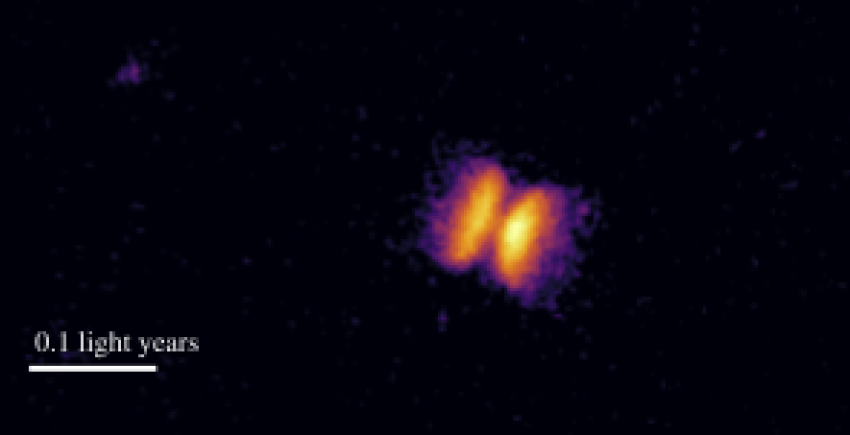

Mysterious high-speed "bullets" – clumps of possibly oxygen-rich gas travelling at up to 20 million miles per hour – have been discovered shooting out of the rarest stellar explosion in our galaxy.
They were spotted after a dust of debris surrounding the Milky Way's only known helium nova finally cleared after more than 20 years, revealing that an unusual stellar system was to blame for the extraordinary explosion.
But the origin of the "bullets" is an enigma that has left astronomers puzzled – nothing of their kind has ever been observed in other novae throughout the universe.
Using observations from multiple telescopes spanning two decades, John Mills, a researcher and PhD student at the University of Warwick, showed that V445 Puppis – which disappeared behind a cloud of its own debris at the turn of the century – consists of a white dwarf feeding on a rare helium star.
The discovery confirms for the first time the nature of the binary system responsible for the Milky Way's only currently confirmed helium nova, providing an unprecedented opportunity to study one of the rarest types of stellar explosions.
The research is being presented this week at the Royal Astronomical Society's National Astronomy Meeting in Birmingham.
A nova is a sudden, explosive outburst of energy in a binary star system. These occur when a white dwarf – the dense remnant left behind after a Sun-like star dies – pulls gas from the nearby companion star. As this material accumulates on the white dwarf's surface, rising temperatures and pressures trigger a runaway thermonuclear explosion.
"The explosion's outflow has now faded sufficiently for us to probe its origin, and so we can confirm that the star system does indeed consist of a white dwarf grabbing material off an extremely rare type of star called a helium star," said Mills.
Almost all known novae are fuelled by hydrogen-rich material. Helium novae are different. Instead, the white dwarf accretes hydrogen-poor gas that is rich in helium, making these eruptions exceptionally rare and poorly understood.
"V445 Puppis has long stood out amongst novae for its complete lack of hydrogen. How could such an event be completely devoid of the most abundant element in the universe?" said Mills.
V445 Puppis is the only known helium nova in the Milky Way, making it astronomers' sole opportunity currently to investigate this unusual class of explosion in detail.
When V445 Puppis erupted in late 2000, it launched an enormous bipolar outflow, initially observed in infrared stretching more than a trillion miles across space. The eruption created a thick disc of dust that completely obscured the star system. For more than two decades, astronomers could study the expanding debris but could not directly determine what kind of stars had produced it.
Finally, the veil of dust thinned enough for the hidden system to emerge.
Combining infrared observations from the European Southern Observatory's Very Large Telescope, optical imaging from the Hubble Space Telescope, long-term spectroscopy from the Southern African Large Telescope, and photometric observations from NASA's TESS mission, Mills was able to reveal the binary system in unprecedented detail.
The observations show that the white dwarf is accreting material from a helium star – a star that has lost its outer hydrogen envelope, probably through previous interactions with its companion. Helium stars are extremely rare: there are estimated to be only a few thousand stripped helium stars among the hundreds of billions of stars in the Milky Way.
Also embedded within the nova's outflowing debris cloud were high-speed "bullets" of possibly oxygen-rich gas.
"The origin of these 'bullets' is a mystery. We suspect that these originated post-outburst, but 'bullets' of this kind have not been observed in any other nova," said Mills.
He also found that the system is actively transferring material once again, indicating that it has resumed the process that eventually led to the original explosion. The observations suggest that the two stars orbit each other every 3.7 days, around twice as long as previously thought.
Understanding helium novae could have far-reaching implications.
Astronomers suspect that repeated helium-rich eruptions may represent one pathway towards producing Type Ia supernovae – some of the brightest explosions in the universe.
"Because these supernovae shine with remarkably consistent brightness, they are special in their use as 'standard candles', used to measure distances to galaxies," explained Mills.
Type Ia supernovae have been used in Nobel Prize-winning research to show that the universe is accelerating.
"The culprits behind this galactic eruption have been an enduring mystery over the past 25 years, which is why it is very exciting to confirm that this helium nova was the result of a helium star accreting onto a white dwarf. I look forward to seeing how this result may help us uncover what powers other similar hydrogen-poor astronomical explosions, such as the famous Type Ia supernovae," said Mills.
Although many questions remain about whether helium novae can ultimately produce Type Ia supernovae, V445 Puppis now provides the clearest laboratory yet for testing that possibility.
ENDS
Media contacts
Sam Tonkin
Royal Astronomical Society
Mob: +44 (0)7802 877 700
Dr Robert Massey
Royal Astronomical Society
Mob: +44 (0)7802 877 699
Megan Eaves
Royal Astronomical Society
Science contacts
John Mills
University of Warwick
Images & video
Image 1: Image from HST showing the bipolar outflow of material ejected by the helium nova V445 Puppis. The progenitor binary star system is just about visible in the centre of the outflow. Also visible are the 'bullets' of gas that were shot out at either end of the outflow. Image taken in 2013 with the F502N filter on Hubble’s Wide Field Camera 3.
Credit: John Mills / University of Warwick
https://drive.google.com/file/d/1s_FzZznBYqTmy9Fle9Uh9gTL5n63jByG/view?usp=drive_link
Image 2: Image from HST showing the bipolar outflow of material ejected by the helium nova V445 Puppis. The progenitor binary star system is just about visible in the centre of the outflow. Also visible are the 'bullets' of gas that were shot out at either end of the outflow. Image taken in 2015 with the F502N filter on Hubble’s Wide Field Camera 3.
Credit: John Mills / University of Warwick
https://drive.google.com/file/d/1bRyvPUEe3UX_Q4nTgsrc0uUw54bdBl3e/view?usp=drive_link
Image 3: Image from HST showing the bipolar outflow of material ejected by the helium nova V445 Puppis. The progenitor binary star system is just about visible in the centre of the outflow. Image taken in 2013 with the F680N filter on Hubble’s Wide Field Camera 3.
Credit: John Mills / University of Warwick
https://drive.google.com/file/d/1EFipX6nbZdkIISwUdTViUpiSQpZd-Jq_/view?usp=drive_link
Image 4: Image from HST showing the bipolar outflow of material ejected by the helium nova V445 Puppis. The progenitor binary star system is just about visible in the centre of the outflow. Image taken in 2015 with the F680N filter on Hubble’s Wide Field Camera 3.
Credit: John Mills / University of Warwick
https://drive.google.com/file/d/1qytv64wVZKm3uNfz3BOw1e6BOmVnIrQ8/view?usp=drive_link
Image 5: Image from HST showing the bipolar outflow of material ejected by the helium nova V445 Puppis. The progenitor binary star system is just about visible in the centre of the outflow. Image taken in 2013 with the FQ727N filter on Hubble’s Wide Field Camera 3.
Credit: John Mills / University of Warwick
https://drive.google.com/file/d/1IQcfH_q-WXbBtIsURJ_PQ5c-9umD6Gwi/view?usp=sharing
Image 6: Image from HST showing the bipolar outflow of material ejected by the helium nova V445 Puppis. The progenitor binary star system is just about visible in the centre of the outflow. Image taken in 2015 with the FQ727N filter on Hubble’s Wide Field Camera 3.
Credit: John Mills / University of Warwick
https://drive.google.com/file/d/1NSX8hx-2GNqI__IaOTXrJsQd4MX3uW5-/view?usp=drive_link
Further information
The talk 'Long-term evolution of the helium nova V445 Puppis and the emergence of the underlying binary' will take place at NAM2026 at 09:45 BST on Wednesday 22 July 2026 in room TLC118/119. Find out more at: https://uobevents-national-astronomy-meeting-2026.eventsairsite.com/block-schedule.
Notes for editors
About the Royal Astronomical Society
The Royal Astronomical Society (RAS), founded in 1820, encourages and promotes the study of astronomy, solar-system science, geophysics and closely related branches of science.
The RAS organises scientific meetings, publishes international research journals, recognises outstanding achievements by the award of medals and prizes, maintains an extensive library, supports education through grants and outreach activities and represents UK astronomy nationally and internationally. Its more than 4,000 members (Fellows), a third based overseas, include scientific researchers in universities, observatories and laboratories as well as historians of astronomy and others.
The RAS accepts papers for its journals based on the principle of successful peer review, following which experts on the Editorial Boards accept the papers for publication. The Society issues press releases based on a similar principle, but the organisations and scientists concerned have overall responsibility for their content.
Keep up with the RAS on Instagram, Bluesky, LinkedIn, Facebook and YouTube.
Download the RAS Supermassive podcast
About the Science and Technology Facilities Council
The Science and Technology Facilities Council (STFC), part of UK Research and Innovation (UKRI), is the UK’s largest public funder of research into astronomy and astrophysics, particle and nuclear physics, and space science. We operate five national laboratories across the UK which, supported by a network of additional research facilities, increase our understanding of the world around us and develop innovative technologies in response to pressing scientific and societal issues. We also facilitate UK involvement in a number of international research activities including the ELT, CERN, the James Webb Space Telescope and the Square Kilometre Array Observatory.
About The University of Birmingham
The University of Birmingham is ranked amongst the world's top 100 institutions. Its work brings people from across the world to Birmingham, including researchers, educators and more than 40,000 students from over 150 countries.
England’s first civic university, the University of Birmingham, is proud to be rooted in one of the most dynamic and diverse cities in the country. A member of the Russell Group and a founding member of the Universitas 21 global network of research universities, the University of Birmingham has been changing the way the world works for more than a century.
The University of Birmingham is committed to achieving operational net zero carbon. It is seeking to change society and the environment positively, and use its research and education to make a major global contribution to the UN Sustainable Development Goals. Find out more about our approach to sustainability.