
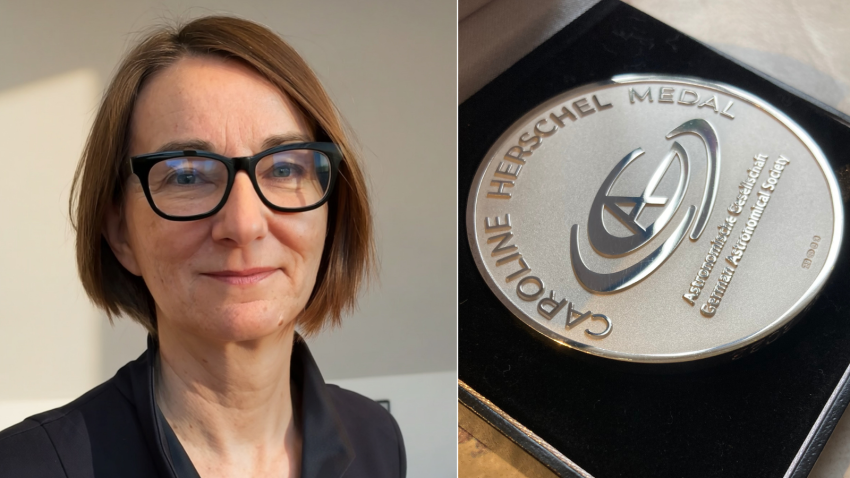

An exoplanet-hunting astronomer who specialises in the detection of Earth-like alien worlds has been awarded the 2026 Caroline Herschel Medal.
Professor Dr Heike Rauer, of the German Aerospace Center (DLR) and Freie Universität Berlin, was recognised for her exceptional service to the astronomical community, her outstanding contributions to exoplanet science, and her leading role in the European Space Agency’s (ESA) upcoming PLATO (PLAnetary Transits and Oscillations of stars) mission.
This is designed to discover and characterise planets outside our Solar System, especially Earth-like planets orbiting Sun-like stars, and is planned to launch in 2027.
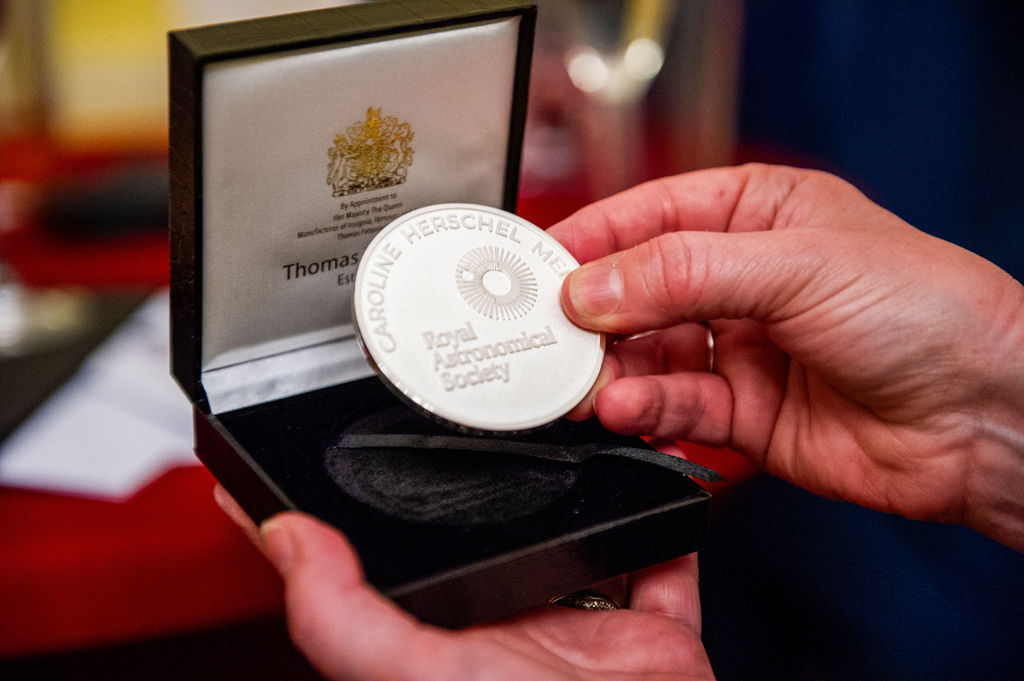
The Caroline Herschel Medal, jointly awarded by the Royal Astronomical Society (RAS) and German Astronomical Society (Astronomische Gesellschaft, AG), celebrates exceptional women astronomers in the UK and Germany.
Professor Rauer’s research has significantly advanced the detection and characterisation of extrasolar planets, with particular emphasis on terrestrial planets and planetary atmospheres.
As Principal Investigator of ESA’s PLATO mission, she has provided decisive scientific and organisational leadership. This includes the coordination of the international consortium of research institutes responsible for delivering the PLATO instrument and major scientific ground segment contributions, enabling the integrated exploitation of exoplanet discovery and stellar asteroseismology.
She has also played a key role in the Next Generation Transit Survey (NGTS), exemplifying successful UK–German collaboration in ground-based exoplanet research. In addition, Professor Rauer is recognised for her sustained commitment to mentoring and for her leadership within the astronomical community.
She studied Physics at the University of Hannover, graduating in 1986, and went on to complete her PhD at the University of Göttingen in 1991, writing her dissertation on cometary plasma tails while working at the former Max Planck Institute for Aeronomy (now the Max Planck Institute for Solar System Research) in Katlenburg-Lindau.
From 1995 to 1997, Professor Rauer held an ESA research fellowship at the Observatoire de Paris–Meudon. She then returned to Germany to join the DLR in Berlin.
While continuing her research at DLR, she obtained her habilitation from the Technische Universität Berlin in 2004 and subsequently taught at the university’s Institute of Astronomy and Astrophysics as Professor of Planetary Physics.
From 2005 to 2017, she headed the DLR Extrasolar Planets and Atmospheres Department. In 2017, she became the head of the Institute of Planetary Research of DLR and joined the Department of Geosciences at Freie Universität Berlin, where her work focuses on planetary geophysics. In 2025, Professor Rauer began working for the DLR board as adviser for ESA matters.
She has also served as head of the instrument consortium for PLATO since 2013.
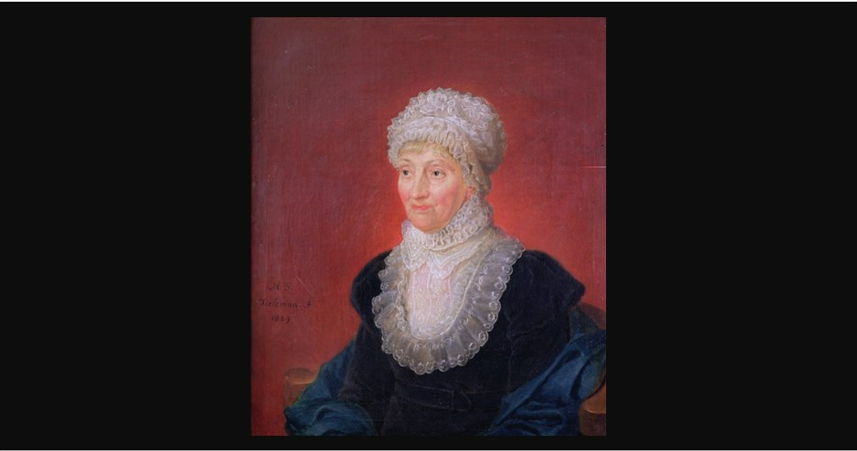
Established in 2021, the Caroline Herschel Medal honours the legacy of pioneering astronomer Caroline Herschel (1750–1848), who made groundbreaking discoveries, including several comets.
The award not only celebrates individual excellence but also highlights the important role of women in advancing our understanding of the universe. It is given out in alternate years to researchers based in the UK and Germany and is designed to honour the longstanding scientific cooperation between the two countries.
Professor Rauer joins an esteemed group of past recipients, including Dr Linda Tacconi, Professor Gillian Wright, Professor Eva Grebel, and Professor Isobel Hook.
The medal will be formally presented at a ceremony on Tuesday, 28 April 2026 at the British Embassy in Berlin, where Professor Rauer will deliver a keynote address on her research.
ENDS
Media contacts
Sam Tonkin
Royal Astronomical Society
Mob: +44 (0)7802 877 700
Dr Janine Fohlmeister
Astronomische Gesellschaft
Tel: +49 331 7499 802
pressofficer@astronomische-gesellschaft.de
Professor Dr Heike Rauer
Deutsches Zentrum für Luft- und Raumfahrt e.V. (DLR)
& Freie Universität Berlin
Images and captions
Caption: Professor Dr Heike Rauer has been awarded the 2026 Caroline Herschel Medal.
Credit: Supplied
Notes for editors
About the Royal Astronomical Society
The Royal Astronomical Society (RAS), founded in 1820, encourages and promotes the study of astronomy, solar-system science, geophysics and closely related branches of science.
The RAS organises scientific meetings, publishes international research and review journals, recognises outstanding achievements by the award of medals and prizes, maintains an extensive library, supports education through grants and outreach activities and represents UK astronomy nationally and internationally. Its more than 4,000 members (Fellows), a third based overseas, include scientific researchers in universities, observatories and laboratories as well as historians of astronomy and others.
The RAS accepts papers for its journals based on the principle of peer review, in which fellow experts on the editorial boards accept the paper as worth considering. The Society issues press releases based on a similar principle, but the organisations and scientists concerned have overall responsibility for their content.
Keep up with the RAS on Instagram, Bluesky, LinkedIn, Facebook and YouTube.
Download the RAS Supermassive podcast
About the German Astronomical Society
The German Astronomical Society (Astronomische Gesellschaft, or AG for short), founded in 1863, is the German national professional association for astronomy and astrophysics. The AG promotes activities in science and research, strengthens exchange between its members and supports the dissemination of science to the public and in education. On the international level, the AG represents the German astronomical scientific community in the European Astronomical Society (EAS) and the International Astronomical Union (IAU). The Council of German Observatories is a central body of the AG, acting as the science policy committee, and representing the common interests of all German astronomical institutions vis-à-vis funding agencies, governments, international organisations and other relevant boards and committees.