




Monthly Notices of the Royal Astronomical Society (MNRAS) is delighted to announce the winner of the 2026 MNRAS Student Prize.
The annual prize recognises papers that, in the view of the MNRAS Editorial Board, are the best submitted in a given 12-month period with a student as the first or corresponding author.
The winner of the 2026 MNRAS Student Prize is Daisaburo Kido, of the University of Tokyo, who was recognised for the paper 'Black Hole Envelopes in Little Red Dots' by Daisaburo Kido, Kunihito Ioka, Kenta Hotokezaka, Kohei Inayoshi, and Christopher M Irwin.
He said: "I am deeply honoured to receive the 2026 MNRAS Student Author Prize. I would like to thank my collaborators for their invaluable support throughout this project, and I hope that our work on Little Red Dots will help stimulate further discussion and observations of these intriguing objects."
MNRAS Editor Professor Martin Ward said: "The understanding of the nature of Little Red Dots (LRDs) is one of the most intriguing issues raised by JWST observations.
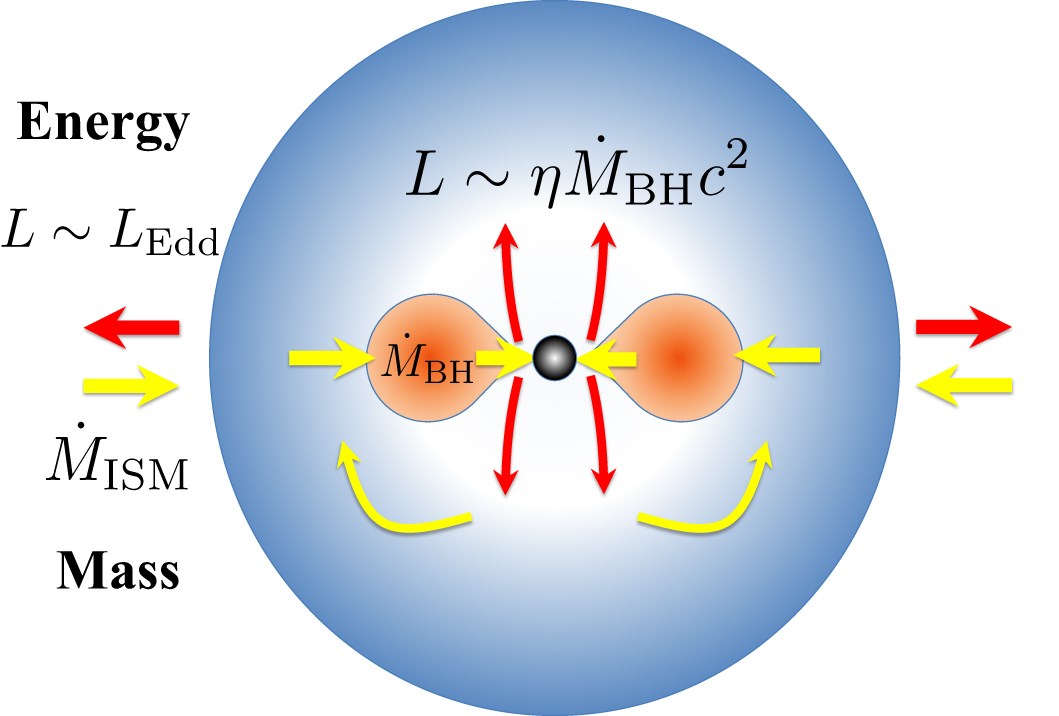
"They propose a scenario that can explain many of the features of LRDs for example; the presence of a photosphere that emerges either within the envelope or in the infalling medium, with a characteristic temperature of 5000–7000 K, near the Hayashi limit.
"The resulting blackbody emission naturally explains the red optical continuum of the distinct V-shaped spectrum observed in most LRDs. Furthermore, the dynamical timescale at the photosphere, ∼ 0.01 pc, is consistent with the observed year-scale variabilities.
"I believe the paper makes a valuable contribution to the debate over the nature of LRDs."
To find out more about the MNRAS Student Prize, visit https://academic.oup.com/mnras/pages/student-awards.
ENDS
Media contacts
Sam Tonkin
Royal Astronomical Society
Mob: +44 (0)7802 877 700
Images & captions
Caption: Daisaburo Kido, of the University of Tokyo, has been announced as the winner of the 2026 MNRAS Student Prize.
Credit: Supplied
Caption: Concept of the BH envelope from the winning paper ‘Black Hole Envelopes in Little Red Dots’. The BH envelope serves to block and gravitationally confine the outflow from the super-Eddington disc. Meanwhile, energy is transported through radiation and convection and radiated away from the envelope surface.
Credit: Daisaburo Kido
Notes for editors
About the Royal Astronomical Society
The Royal Astronomical Society (RAS), founded in 1820, encourages and promotes the study of astronomy, solar-system science, geophysics and closely related branches of science.
The RAS organises scientific meetings, publishes international research journals, recognises outstanding achievements by the award of medals and prizes, maintains an extensive library, supports education through grants and outreach activities and represents UK astronomy nationally and internationally. Its more than 4,000 members (Fellows), a third based overseas, include scientific researchers in universities, observatories and laboratories as well as historians of astronomy and others.
The RAS accepts papers for its journals based on the principle of successful peer review, following which experts on the Editorial Boards accept the papers for publication. The Society issues press releases based on a similar principle, but the organisations and scientists concerned have overall responsibility for their content.
Keep up with the RAS on Instagram, Bluesky, LinkedIn, Facebook and YouTube.
Download the RAS Supermassive podcast