


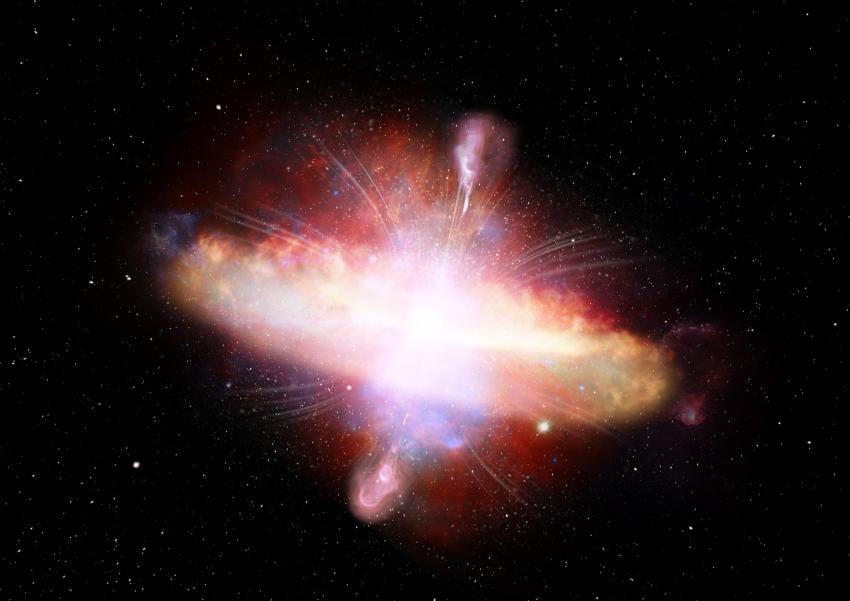

Almost every known galaxy contains a supermassive black hole at its heart, including our own Milky Way, which have masses millions to billions that of our Sun. Understanding how these monster black holes shape their surroundings is crucial to our understanding of how galaxies evolve. Some black holes are very energetic, launching powerful winds and jets, and are referred to as “active”. We have recently found a population of these active black holes that are enshrouded by dust that exhibit peculiar properties. An emerging theory is that these dusty black holes represent a key stage in galaxy evolution.
Speaker Bio: Dr Vicky Fawcett is a Fellow at the European Southern Observatory (ESO) based in Munich. Previously, she did a postdoc at Newcastle University and a PhD at Durham University. Dr Fawcett’s research focuses on how galaxies evolve, in particular focusing on extremely bright galaxies known as “quasars”. She is involved in two major spectroscopic surveys: the Dark Energy Spectroscopic Instrument (DESI) and the upcoming Multi-object Optical and Near-IR spectrograph (MOONS). Outside of research, Dr Fawcett is very enthusiastic about outreach, having previously designed an astronomy museum exhibition based in Newcastle, presented at many astronomical societies and schools, and was awarded the 2025 Caroline Herschel Prize Lecture.
Save Your Spot
Accessibility Information
Please note that this venue is currently not wheelchair accessible as the ramp is temporarily out of order, and step-free access is unavailable.
We sincerely apologise for any inconvenience caused. We are committed to improving accessibility and are working to address this.
If you have any specific access requirements or questions, please contact us at events@ras.ac.uk or call us on 020 7734 4582 .