


This is a rolling grant scheme. Applications are considered at two points each year, with cut-off dates of 30 September and 31 March. Any application received after a cut-off date will automatically be carried forward and considered in the next funding round.
The Royal Astronomical Society are enthusiastic supporters of a wide range of public education and outreach activity related to Astronomy and Geophysics. This work can help inspire new generations of scientists, share the fascinating work going on throughout the world and inform the public about the important part Astronomy and Geophysics plays in all of our lives.
The Education and Outreach small grant scheme is one way we aim to achieve this.
This scheme provides funding of amounts between £250-£5000 for Astronomy and Geophysics education and Outreach projects. It has an annual cycle with two funding deadlines each year. These are usually at the end of March and September.
What types of projects receive funding: A range of public outreach activities are funded, such as public events, training workshops, broadcasting or podcasting, and educational material. Bids for funds for general equipment such as telescopes, laptop computers, scanners, digital projectors and the like will usually only be successful if they form an integral part of a specific project that has clear E&O targets. While the Society is willing to consider application to support or expand existing schemes, those that show a clear path to sustainability will be more likely to succeed.
Previously funded projects: Below are a few examples of previously funded projects from this scheme. The RAS’s Education and Outreach small grants scheme is very open as willing to fund quite broad ranges of Astronomy and Geophysics related projects. So these example are to give an idea of that range.
1. Brick by Brick (University of Cardiff)
A Lego Satellite workshop delivered by the physics department of the University of Cardiff. This project delivered 16 sessions in 9 schools within the South Wales area. With over 400, 7-11 year olds taking part.
2. Mathematics, Physics and Astronomy Summer School (MPASS) -Acornhoek Institute for Science and Technology (AIST), Mpumalanga province, South Africa.
A summer school for high school learners in grade 11 with the aim of helping them improve their performance in maths and science and also inspire them to pursue careers in STEM and specifically astronomy.
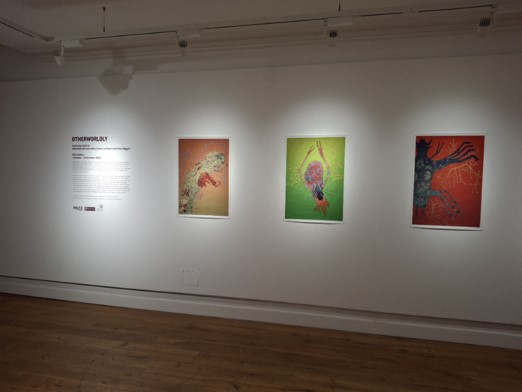
3. “Otherworldly” Exhibition at the Peltz Gallery - Birkbeck University
An exhibition on the role of the arts in communicating astrobiological research to the Peltz Gallery at Birkbeck College, University of London. Communicating astrobiological research to new audiences and address issues of engaging underrepresented groups in the sciences. By far the majority of event attendees were not from a science background. For the project itself we successfully recruited 2 visual artists and 2 sound artists to create the works featured in the exhibition. Receiving 1900 visits as well as fully booked events programme.
Who can apply: Almost anyone looking to fund a good Astronomy and/or Geophysics Education and Outreach project. This scheme is a very inclusive and both people and organisations can apply. Applicants can be a fellow of the society, members of the RAS friends programme, and people and organisations with no links to the society.
If you are unsure whether your project is suitable, or would like some help with preparing your application, our Education and Outreach team are happy to discuss your ideas. outreach@ras.ac.uk
How much could I be awarded: This award scheme is only for projects between £250-£5000. This would be for a one-off application.
How it works: Put your application together that fits the funding criteria and clearly explains what it is, how it will work and what you are aiming to achieve with it.
Once you have submitted your E&O grant application it goes to our funding panel. Applications are competitive, and we receive more applications than we have funding available to support. After the application deadline, projects are reviewed by the funding panel against the funding criteria and against other applications to try to support a wide range of impactful projects.
Funded projects will typically be delivered within one calendar year of the funding (or make clear why that is not the case in the funding application).
Promotion and championing your projects: Once you’ve completed your project how can the RAS celebrate and share this amazing Education and Outreach projects. This could be through case studies, news stories, articles in our A&G magazine, mailings to our membership or sharing at astronomy, geophysics or educational and outreach conferences and events.
To do this we like all funded projects to collect and document their projects in action. This could be a few photos or video of the project happening, writing a short news story and sharing any links to any external new stories or media that has been made about the project.
Evaluation:
We are keen to know about how your project does. We ask all funded projects to send us evaluation of their project of no less 450 words outlining how it all went for you? did it all follow your original plans? What went right? What could have gone better? Who and how many people took part in the project? Any valuable lessons you learnt from it? Now the project has been completed what next?
Evaluation can take many shapes and forms appropriate to the type and scale of your activity. Make sure in your application let us know what you’re trying to achieve and what and how you will collect information to measure those outcomes.
On completion of a funded project, applicants are required to submit an evaluation of no less than 450 word. Should the project not be completed within 12 months of the award a short intermediate update is also required to report on the project's status.
The evaluation report is a condition for any funding, and the quality of the evaluation will be considered when judging any future applications.
Your evaluation should aim to:
- Establish whether the objectives of your project have been met
- Determine the impact your project has had (size of audience reached, age range and diversity of groups etc.)
- Identify how the project could have been more effective
- Identify whether there have been unintended outcomes and what these were
Award criteria:
- The project must be an Education and Outreach one about Astronomy or Geophysics.
- The maximum E&O grant that can be applied for is £5,000 and at most one award per year will be made to any one person/ organisation. A budgetary breakdown of the whole project (not just the amount asked for) must be included.
Successful applications will meet some, or all, of the following criteria:
- Projects that promote greater interest in and understanding of astronomy or geophysics
- Activities proven to interest the wider community and, in particular, young people in astronomy or geophysics
- Projects that have clear target audiences, a good strategy for engaging them, and well-defined benefits for the audience
- Projects that can be demonstrated to have a wide reach, impact and/or lasting legacy
- Projects that are cost-effective
- Projects that are innovative
- Projects demonstrating matched funding, or support in kind, to cover some costs of the whole
The following will not normally be funded:
- Staff costs and capital expenditure: unless it can be demonstrated that these are critical to the success of the project and do not normally constitute more than 50% of the grant awarded
How do I apply:
To apply you will need to setup an account on our website, and then follow the link here to fill in and submit the application form.
APPLY HERE
If you have any issues or questions about the application process, you can email: awards@ras.ac.uk If you’d like to discuss a potential project idea with our Education and Outreach team you can contact them by emailing: outreach@ras.ac.uk